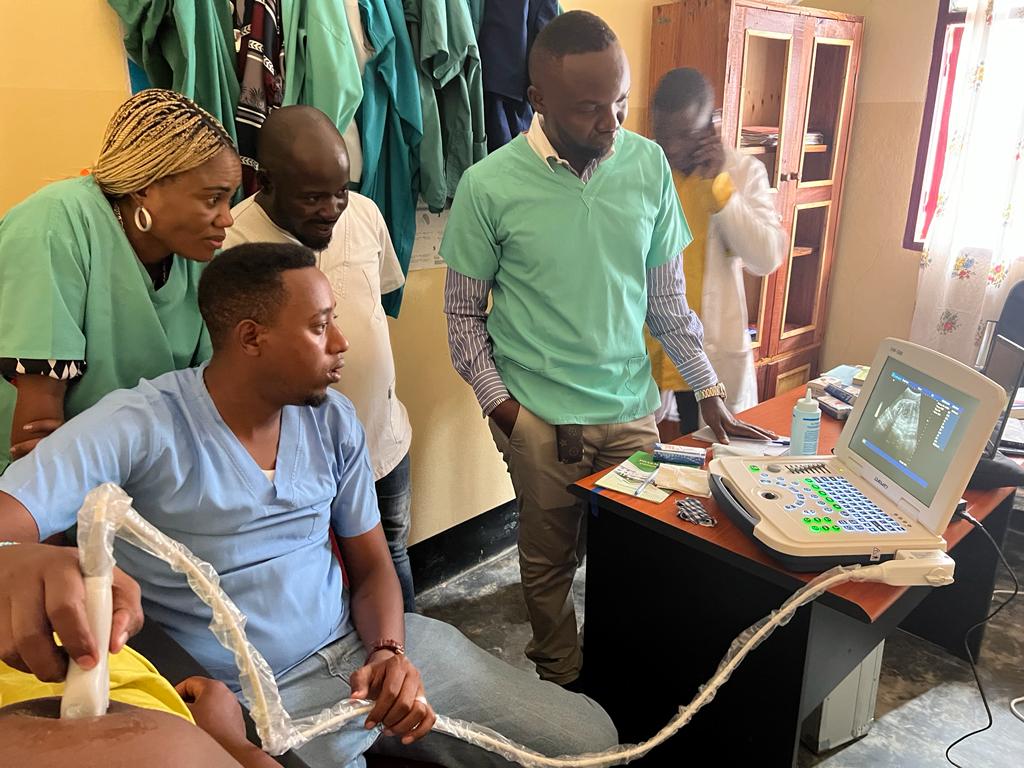


March 10, 2025, Uvira — Throughout the year of 2024, ADED supported five health centers (Kabimba, Kigongo, Kabindula, Kilomoni Croix, and Kalundu CEPAC) in improving their infrastructure and services in the areas of prevention, maternal and child healthcare, and community sensitization in Uvira, Democratic Republic of Congo (DRC), with support of AFAS Foundation. The goal was to strengthen and improve medical care for pregnant women, mothers, and children with disabilities, and to increase community awareness. As a result of these improvements in the five health centers in Uvira, it became clear earlier this year (2025) that three other health centers (Kavimvira, Kalundu Catholic, Rombe) and the Saint Paul Hospital in Uvira decided to purchase an ultrasound device using their own financial resources. More health centers were also motivated to do so, but faced financial shortages due to limited funding and revenue from user fees. They continue to advocate with the local government to support their needs.
Initially, the health centers that had purchased their own ultrasound machines set high user fees ($15 per consultation), which led to a decrease in the number of pregnant women seeking these services. The Uvira Health Zone therefore organized a meeting with community representatives, civil society organizations, local leaders, healthcare workers, and health centers to harmonize the user fees. They agreed on a fee of $4.50 per consultation for all nine health centers in Uvira. As a result, the services became more affordable, leading to an increase in the number of pregnant women attending consultations. In total, 9 out of the 22 health centers in Uvira now have an ultrasound machine, which adds on the improvement of maternal and child healthcare services in Uvira, Eastern DRC.
A Doctor's Perspective: How the Ultrasound is Transforming Care in Kabimba, Uvira
In the Moyen Plateaux lies the Kabimba Health Center, which is remote and far from the hospitals in Uvira. The center is the first—and often the only—point of care for pregnant women in remote villages. Without an ultrasound, complications were often detected too late, putting lives at risk.
Dr. Guy, a dedicated doctor at the Kabimba Health Center, explains:
“In the past, we relied solely on physical examinations. Many women arrived in distress, and all we could do was react—sometimes too late.”
That changed with the support of ADED, through which Kabimba received an ultrasound machine. Now the health center can detect complications early and provide better healthcare to women and children. One such case was Mama Furaha, who came for a pregnancy consultation. At the health center, they discovered that her baby was in a breech position. Due to the early medical intervention, she was able to give birth safely—without being classified as a high-risk case and without needing additional medical assistance.
The DPRP/Tunafasi Program in Uvira has not only saved lives but also transformed the community’s mindset.
“The community now has more trust in medical care, and even we as doctors see the difference,” says Dr. Guy.
Other health centers in Uvira are now also lobbying for ultrasound equipment and are putting pressure on health authorities to help make this possible.
“We are still a basic health center, but with the ultrasound machine we can prevent emergencies instead of only responding to them,” Dr. Guy concludes.