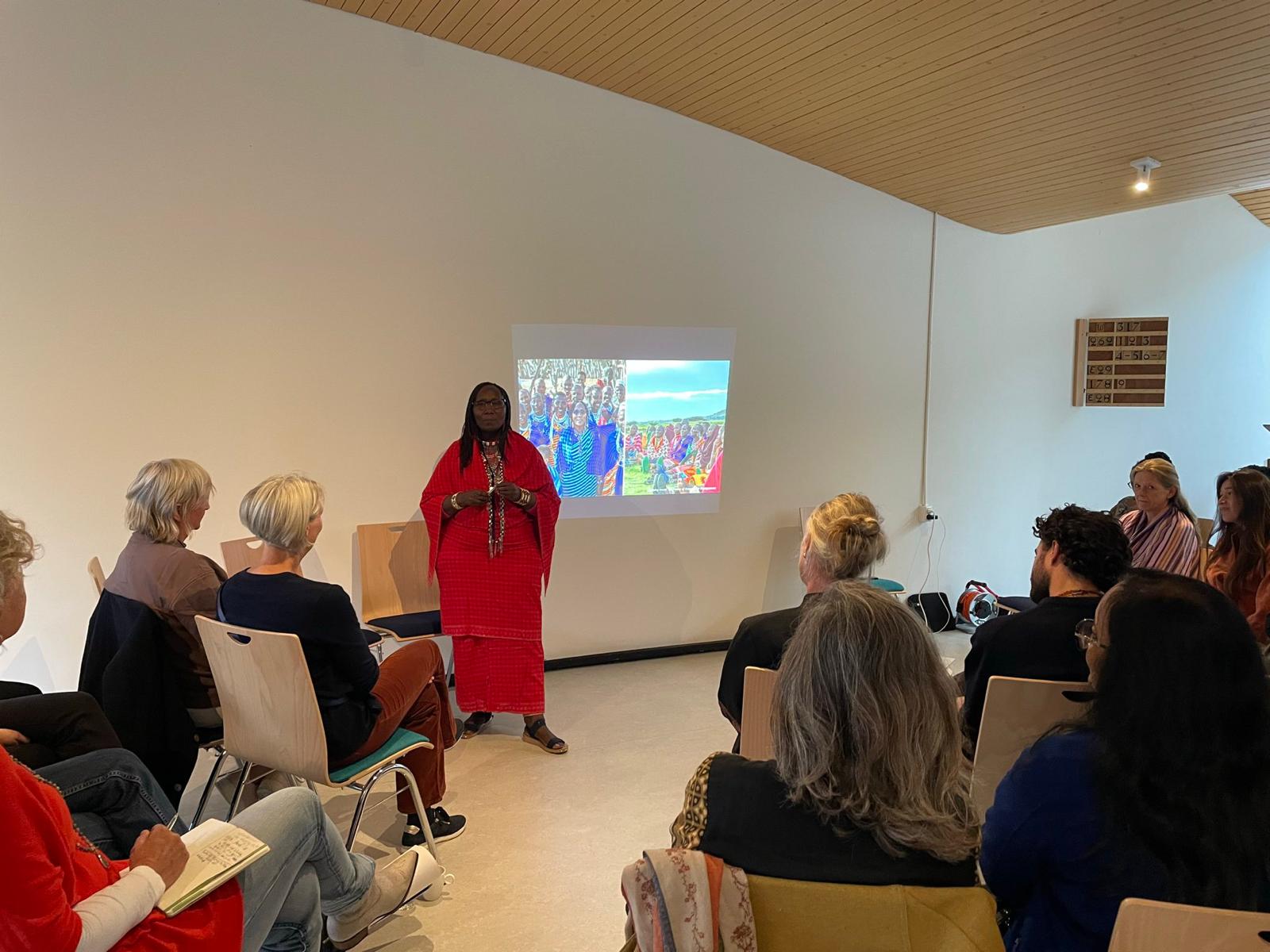

September 26th, 2025, Amsterdam - On Friday afternoon, the TUNAFASI team organized a small learning dialogue, together with the Pastoral Women’s Council (PWC) from Tanzania. The afternoon began with the life story of Maanda Ngoitiko, co-founder and director of PWC. She is a pastoralist woman from the Maasai community in northern Tanzania. For more than twenty-eight years, she has been working and investing in her community, advocating for the justice, equity and rights of Indigenous pastoralist and agro-pastoralist women and girls. With this, she is shaping the future of human rights among Indigenous communities as a changemaker in Tanzania.
During the event, Maanda shared her personal journey, recounting how, at the age of 13, she resisted the cultural tradition of a forced arranged marriage to continue her education and pursue her aspiration of becoming a teacher. Her determination to prioritize education for girls and young women laid the foundation for her lifelong commitment to advocate for the rights and empowerment of Indigenous pastoralist and agro-pastoralist women and girls in Tanzania. In addition to this, Maanda and her team have also become prominent activists for the protection of land, cultural and socio-economic rights of Indigenous communities.
The second part of the afternoon, a discussion was held on the true understanding of localization and locally-led development, particularly in relation to how development aid should be implemented meaningfully and led by local changemakers and communities themselves. The discussion was facilitated by Julius Weise (TUNAFASI Team), with a panel with Maanda, Ruth Kihiu (Head of Programs and Operations at PWC), and Sandra Cats (Advisor for Humanitarian Aid and Locally-Led Adaptation at the RVO - Rijksdienst voor Ondernemend Nederland), who works for the innovative program of Reversing the Flow, and Melau Makko, a passoionate youth champion within PWC.
Key Outcomes of the Discussion
The discussion highlighted fundamental challenges and opportunities in how to actually move towards localization and locally-led development. At the core of the challenge that hinders this process lies an inequality in decision-making and power within current development and funding systems. A predominantly project-based, short-term funding framework limits the ability for organizations and social movements in the Global Majority to drive sustainable change and impact. There is the need to move away from project-based funding and shift more towards long-term, unearmarked investments in organizations, leadership, and movements.
To drive this process, the discussion also moved towards the need of having a clearer and shared understanding of what trust-based partnership means. Meaningful partnerships require more than funding alone and must be grounded in:
- Solidarity and trust
- Meaningful participation and ownership in decision-making
- Flexibility and openness to changing local realities and context
- Transparent communication and dialogue
- Shared accountability, responsibility, and risk
Trusted partnership is also about an exchange of abundances, including knowledge, experience, tools, and networks, recognizing the mutual value that both partners bring in.
Besides this, strong emphasis was placed on supporting human rights defenders at the frontlines, ensuring they have the resources and space to continue their critical work in challenging and high-risk environments. This goes hand in hand with investing in strong local leadership and resilient local NGOs and movements, enabling them to sustain their mandates and strengthen long-term impact.
Finally, the discussion also touched upon the importance of meaningfully involving youth as agents of change. Their input and perspectives are essential for building inclusive and sustainable societies. With this, Melau illustrated the vital role that young leaders play in amplifying marginalized voices and driving innovative solutions to local and global challenges.